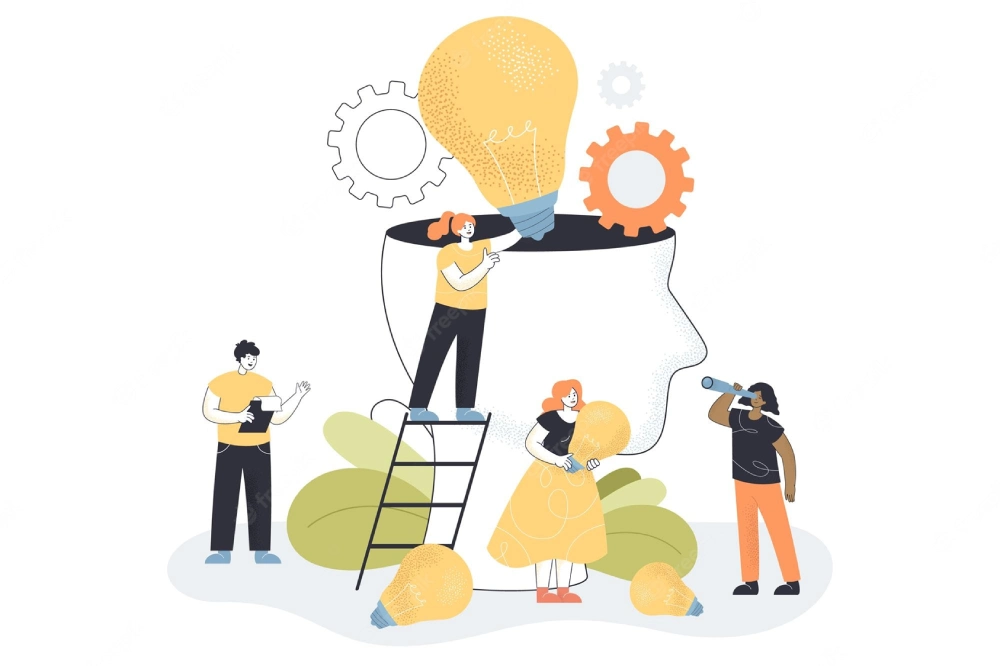
Flexibility Fluency Imaginative Elaboration
The Creativity Craze
Aim of the chapter :
Creativity elevates social and emotional development by integrating feelings with tasks. By asking the child to paint, draw, or tell a story, about how they're feeling we encourage them to express themselves better. These types of activities help children, who are not able to verbalize, or express their feelings.
The art of observation
Aim of the chapter :
"God is in detail" --- Mies van der Rohe.
Detail includes observational & auditory skills to document any detail asap. The initiation of any type of direct or statemented art is the capability to reflect and capture the real world. Observational art/design is drawing or painting from life sotoonvey
and interpret people and objects as faithfully as possible. Creative minds must see all the details of a scene and reproduce them.
Make the difference with line, shape, forms & colours
Aim of the chapter :
Composition is what guides our eyes through any piece of art and gives importance to the subject about the rest of the components. Composition through flow, direction, and visual balance, helps drive the story behind the child's work and grabs viewer's the attention.
Introduction to design thinking
Aim of the chapter :
Design thinking is an educational approach that stresses creative problem solving for children with the added value of an entrepreneurial outlook. It's an approach that could and should lead to more creative minds evolving entrepreneurship - or at least, to a more entrepreneurial way of facing challenges in the future.
Introduction to perspective
Aim of the chapter :
Perspective drawing techniques aims to create the linear illusion of depth. As objects get further away from the viewer they appear to decrease in size at a constant rate. This very sensation needs to be visually built among children to draw things in correct way possible.
Expressing 3D forms in 2D Planes
Aim of the chapter :
The skill of drawing things in 3D or in the most realistic way possible on a 2D plane is important to understand various aspects of realism. It provides a level of understanding in depth that rough sketches or 2D objects can be interpreted as 3D after adding depth & shadow. It also helps explore the physical aspects of any art or design without surrendering to physical limitations
Introduction to logical thinking
Aim of the chapter :
Logical thinking, in combination with other cognitive skills, is an important skill children use during all kinds of daily situations. It helps you to make important decisions, discern the truth, solve problems, come up with new ideas and set achievable goals.
Nature Study, life drawing & Composition
Aim of the chapter :
NATURE-STUDY, as a process, is seeing the things that one looks at, and the drawing of proper conclusions from what one sees. Its purpose is to educate the child in terms of his environment, to the end that his life may be fuller and richer.
Creative Exercises
- Cut & glue - explore various shapes & their combinations
- Make composition with pebbles & sand.
- Clay modelling - basic forms
- Making composition using paper collage.
- Make best out of waste - anything you like.

- Practice sketches without eraser - build your confidence.
Analytical Exercises :
- Plan out how to achieve your life goals using flow chart
- Write a small paragraph on what can be the best thing you want to create & why ?
- Click photographs of natural patters & sequences that you find in nature.
- Make your own puzzle and let others solve it.
- Overlap multiple images to find a common natural element.